If you are choosing a shockwave system for your clinic, start with how you plan to use it every day—not just the price or one specification. This guide helps you compare your options through the lens of your patients, treatment goals, and workflow, so you can choose a system that continues to support your clinic after the initial purchase.

1 Patient Volume and Treatment Focus
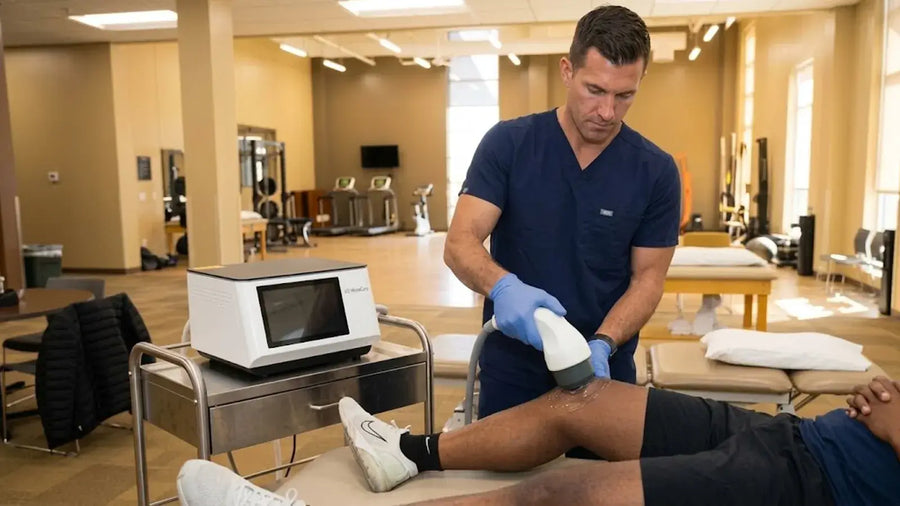
Patient volume affects the workflow a clinic needs. Busy PT, chiropractic, and rehabilitation clinics usually need a device that moves smoothly from one appointment to the next. Simple controls, quick setup, handpiece comfort, and practical treatment-head options become important when several clinicians use the system throughout the day.
A specialty practice with fewer but more complex cases may place greater value on precise treatment targeting and advanced clinical capability. The right system should support both the clinic’s most common presentations and its expected weekly treatment volume.
2 Clinical Presentation and Treatment Target
The diagnosis alone does not determine whether radial or focused technology is the better fit. The treatment field, the clinical target, and the intended treatment approach also matter. Radial treatment may be considered when the plan involves broader tissue coverage. Focused treatment may be considered when a smaller, more clearly localized target is central to the treatment plan.

| Clinical Presentation / Target | Radial May Be Considered When | Focused May Be Considered When |
|---|---|---|
| Plantar heel pain | The symptomatic area is broader or includes surrounding plantar soft tissue | A localized insertional target or calcification has been identified |
| Achilles tendinopathy | The clinician intends to cover a broader or more superficial tendon region | The target is localized and requires more depth-specific positioning |
| Patellar tendon pain | Sensitivity extends through a larger tendon or surrounding soft-tissue area | A clearly defined tendon region or insertion is being targeted |
| Lateral elbow tendinopathy | The plan includes a broader extensor muscle-tendon area | Examination identifies a localized tendon-origin target |
| Shoulder pain | The treatment field includes a broader muscular or superficial soft-tissue region | A specific tendon insertion or calcific deposit has been identified |
| Myofascial trigger points | Multiple points or a larger muscle area require coverage | A small, clearly localized target is the primary concern |
| Calcific tendinopathy | Surrounding tissue is included in a broader treatment strategy | Precise delivery toward a localized deposit is intended |
This matrix supports equipment selection and clinical discussion. Treatment decisions, parameter selection, and patient suitability remain the responsibility of the treating clinician.
3 Device Performance and Everyday Usability
Technology must work in a real treatment room, not only on a specification sheet. The most useful comparison points are:
- Adjustable treatment settings that suit the clinic’s intended use
- Easy parameter changes during treatment
- A comfortable handpiece for repeated daily use
- Treatment heads suited to common body areas
- Clear presets for efficient workflow, plus manual adjustment when needed
- A structure that is easy to move, position, and store
Energy and frequency numbers should be interpreted carefully. Radial systems are commonly described in bar, while focused systems may use energy flux density in mJ/mm². These measurements are different and should not be compared as though they represent the same value.
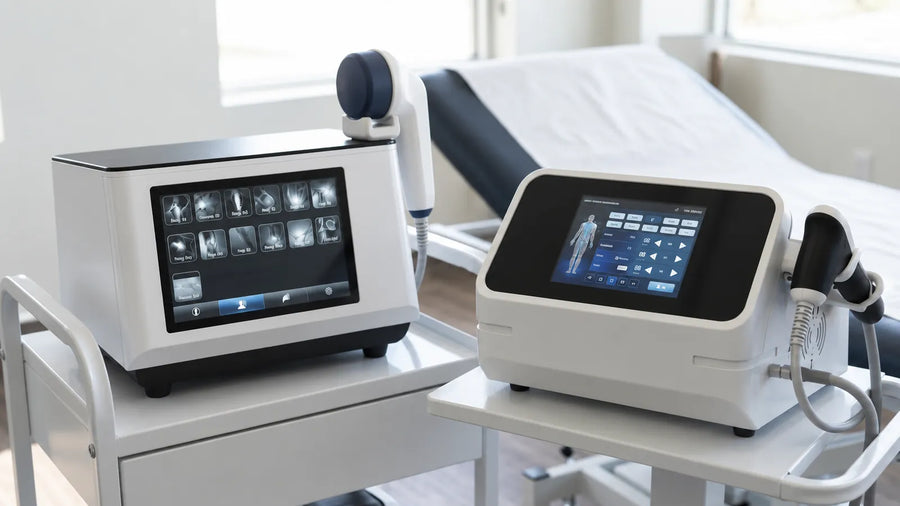
WaveCura Radial is designed for everyday clinical flexibility, with six treatment heads, handpiece adjustment, an 8-inch display, ten preset programs, and a custom mode for clinician-controlled settings.

4 Clinical Team and Training
A device creates value only when the clinical team can use it with confidence. When several clinicians share one system, training, clear controls, and easy setup matter as much as the core technology.
- Initial device training
- A clear user manual
- Guidance on treatment-head use and parameter adjustment
- Ongoing technical support
- Clinical resources for the team
The goal is to make shockwave therapy a service that the whole team can deliver consistently, rather than a device operated by only one person.
5 Total Cost and Patient Pricing Structure
The equipment quotation is only one part of the investment. A complete review should include standard treatment heads and accessories, training and shipping, main-unit and handpiece warranty, replacement parts, maintenance, repair process, technical support, and financing or payment options where available.
Shockwave therapy may be incorporated into an existing rehabilitation or chiropractic plan, offered as a separate self-pay treatment, or included in a multi-visit package. The best pricing structure reflects the local market, appointment time, clinical value, and the clinic’s current model of care.
6 Insurance Reimbursement and US Regulatory Status
Insurance reimbursement should be verified before it becomes part of a revenue forecast. Coverage can vary by payer, state, clinical indication, provider contract, and individual patient plan. Some clinics provide shockwave therapy primarily as a self-pay service, while others may have a billing pathway for selected circumstances.
For medical-use equipment in the United States, FDA establishment registration, product listing, 510(k) clearance, and premarket approval are different concepts. The supplier should be able to identify the specific product, manufacturer, intended use, and applicable FDA record.
7 Maintenance Warranty and Long Term Support
Professional equipment needs dependable support after delivery. Before purchasing, clinics should confirm warranty coverage for both the main unit and handpiece, technical-support response time, repair availability, replacement-part availability, and support provided after installation.
A responsive support structure can be more valuable than a lower initial price, especially when the device is used frequently.

Choosing the Right WaveCura System
WaveCura Radial is suited to clinics seeking broad, high-frequency capability for everyday musculoskeletal and rehabilitation care. WaveCura Focused is suited to clinics that place greater emphasis on precise energy targeting and are developing advanced sports medicine, pain-management, or orthopedic rehabilitation services.
The right choice is the one that fits the clinic’s patients, treatment direction, team workflow, and long-term plan.
References
- Efficacy and Safety of Extracorporeal Shock Wave Therapy for Orthopedic Conditions: A Systematic Review on Studies Listed in the PEDro Database — British Medical Bulletin.
- Best Practices for Extracorporeal Shockwave Therapy in Musculoskeletal Medicine: Clinical Application and Training Consideration — PM&R.
- A Systematic Review of Shockwave Therapies in Soft Tissue Conditions: Focusing on the Evidence — British Journal of Sports Medicine.
- Effect of Shockwave Treatment for Management of Upper and Lower Extremity Musculoskeletal Conditions: A Narrative Review — PM&R.
- Extracorporeal Shock Wave Therapy is Effective in Treating Chronic Plantar Fasciitis: A Meta-Analysis of RCTs — Clinical Orthopaedics and Related Research.