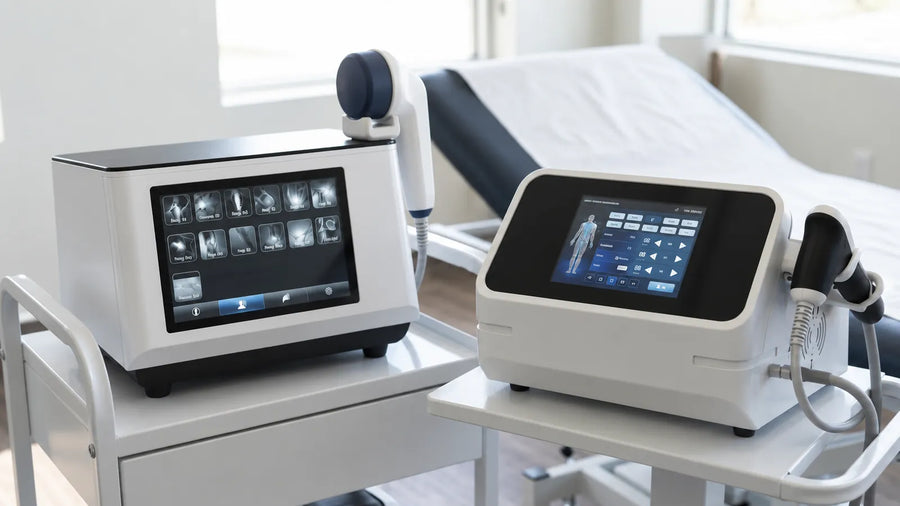
What Is Shockwave Therapy
Extracorporeal Shockwave Therapy (ESWT) is a completely non-invasive acoustic physical therapy; its operating principle differs fundamentally from common electrical stimulation therapies, as no electric current is introduced into the body during the procedure.
In practice, the therapist simply applies medical coupling gel to the skin and presses the applicator firmly against the affected area to non-invasively transmit high-energy acoustic mechanical waves into deep subcutaneous tissues. The rhythmic tapping sound heard in the clinic does not stem from electrical stimulation but from purely physical mechanical action within the device: in pneumatic ballistic systems, a high-speed airflow drives an internal alloy projectile to strike the applicator head, whereas focused devices instantly discharge high-voltage electricity within a sealed water-filled chamber to generate highly penetrating acoustic wave pulses.
These acoustic waves differ from both the superficial high-frequency vibrations of fascia guns and the thermal effects of standard ultrasound therapy. In orthopedics and sports rehabilitation, ESWT targets stubborn chronic tendon degeneration, fascial strain, and pathologies at musculoskeletal junctions. By penetrating superficial barriers, these high-energy mechanical waves deliver targeted mechanical stimulation directly to deep-seated, damaged tissues, thereby promoting the restoration of local microcirculation and reactivating the body's self-healing mechanisms.
How It May Affect Tissue
The specific biological responses triggered by shockwaves remain a subject of ongoing research within the medical community.
The core mechanism widely recognized in clinical practice is "mechanotransduction," wherein cells subjected to pressure sense external acoustic-mechanical stimuli and convert them into a cascade of biochemical signals. Existing literature indicates that this process is often accompanied by the desensitization of local pain pathways, improved microcirculation, enhanced cellular repair activity, and the remodeling of collagen fibers. However, as these are underlying biological responses influenced by factors such as individual constitution, the stage of the injury, and treatment parameter settings, they do not necessarily manifest to the exact same degree in every patient.

Focused Shockwave and Radial Pressure Wave
Both technologies are commonly described as shockwave therapy, but they do not produce the same waveform. Focused systems concentrate a true shockwave at a selected depth. Radial systems usually use compressed air and a projectile to create a pressure wave that is strongest near the applicator and spreads through a broader, more superficial area. [1]
| Feature | Focused shockwave | Radial pressure wave |
|---|---|---|
| Energy pattern | Concentrated at a selected depth | Highest near the applicator, then disperses |
| Typical target | Deeper or precisely localized tissue | Broader, generally more superficial soft tissue |
| Generation | Electromagnetic, electrohydraulic, or piezoelectric | Usually pneumatic and projectile based |
| Clinical choice | Useful when depth and focal accuracy matter | Useful when a wider treatment field is appropriate |
Neither technology is automatically better. Selection depends on the diagnosis, target depth, tissue type, treatment area, available evidence, patient tolerance, and clinician training. Pressure in bar on a radial system is not directly equivalent to energy-flux density on a focused system.

What Conditions Is Shockwave Therapy Used For
Although shockwave therapy is applied across various clinical fields, the level of evidence-based support varies depending on the specific tissue being treated.
In routine physical therapy, the most common and well-established therapeutic benefits are observed in cases of stubborn tendon disorders. Examples include plantar fasciitis (characterized by pain upon taking the first steps in the morning), recurrent insertional Achilles tendinopathy, jumper's knee, chronic tennis elbow, and calcific deposits within the rotator cuff. It also offers significant relief for patients with greater trochanteric pain syndrome who struggle to sleep on their sides.
Focused shockwave devices offer a distinct set of clinical applications. When targeting deep-seated skeletal tissue, focused waves can stimulate healing in cases of non-union (where repair has stalled), delayed fracture healing, or recurrent stress-related bone injuries.
Beyond traditional orthopedics, inquiries are frequently made regarding other conditions. However, using this therapy for osteoarthritis, chronic muscle spasms, refractory wounds, or vasculogenic erectile dysfunction requires further rigorous clinical validation and regulatory approval. Regardless of the therapy's broad theoretical potential, an accurate clinical diagnosis remains an essential, non-negotiable first step before treatment begins.

What Happens During Treatment
1. Assessment and Targeting
The provider reviews the diagnosis, medical history, medications, treatment area, and contraindications. The target may be located by examination, palpation, or imaging. The clinician then selects the applicator, energy, frequency, pulse count, and patient position. [1,6,7]
2. Energy Delivery
Coupling gel is applied, and the handpiece is placed against the skin. Treatment may feel like repeated tapping, pressure, or a deep ache. The provider may adjust the output according to the protocol and the patient's response. A focused applicator may stay over a defined target, while a radial applicator may move across a broader area.
3. After the Session
The area may feel tender for a short time. Some patients return to ordinary activities immediately; others need temporary changes to exercise or loading. Session number and treatment interval vary, so a fixed promise such as three sessions for every diagnosis is not appropriate. Improvement may continue over several weeks.

Potential Benefits
For appropriately selected patients, potential advantages include noninvasive outpatient delivery, limited interruption to daily activity, and improvement in pain or function for certain chronic tendon conditions. A recent meta-analysis of 45 randomized trials found an overall reduction in pain across several tendinopathies, while also reporting substantial variation among studies. [3]
- No incision and usually no injection
- A treatment option that may complement exercise-based rehabilitation
- Potential improvement in pain and function for selected conditions
- A possible step before more invasive care in suitable cases
These are potential benefits, not promises. Results depend on the diagnosis, device type, dose, treatment technique, rehabilitation plan, and individual patient factors. Shockwave therapy should not be described as guaranteed tissue regeneration or a guaranteed way to avoid surgery.
Side Effects and Safety
Common temporary reactions may include:
- Discomfort during treatment
- Soreness or tenderness afterward
- Temporary redness or mild swelling
- Bruising
- Temporary tingling or numbness
Less common concerns include hematoma, nerve irritation, prolonged pain, or vasovagal symptoms such as dizziness. In a randomized study of a specific tennis-elbow protocol, redness was the most frequent recorded reaction, but results from one protocol should not be treated as universal side-effect rates. [5]
When Treatment May Not Be Appropriate
Contraindications depend on waveform, energy level, and treatment area. Professional guidance identifies a malignancy or fetus in the treatment field as contraindications for radial and low-energy focused treatment. High-energy focused treatment requires additional avoidance around structures such as lung tissue, brain, spine, and growth plates, and in severe coagulation disorders. [1,2]
Active infection, complete tendon rupture, clinically important anticoagulant use, reduced sensation, implanted devices near the treatment path, or other conditions that affect healing may also require individual review. The treating professional must follow the device labeling and applicable clinical guidance.
How Clinicians Choose a System
A practical decision starts with the target, not with the highest available setting. Focused technology may be preferred when depth and localization are important. Radial pressure wave technology may suit a broader, more superficial treatment field. Some practices use both because they serve different clinical workflows.
- Confirmed diagnosis and stage of the condition
- Target depth, size, and tissue type
- Required energy distribution and applicator options
- Patient tolerance and relevant safety factors
- Available evidence, device labeling, and clinician training
Frequently Asked Questions
Is shockwave therapy painful?
It can be uncomfortable, especially near bone or sensitive tissue. Intensity can often be adjusted. Maximum pain is not the treatment goal.
How many sessions are needed?
There is no universal number. The planned course depends on the diagnosis, device, protocol, response, and rehabilitation program.
Is radial shockwave the same as focused shockwave?
No. Radial devices create a dispersing pressure wave, while focused systems concentrate a true shockwave at a selected depth.
When should progress be assessed?
Some people notice an early change in pain, but a clearer functional response may take several weeks. Lack of immediate relief does not automatically mean treatment has failed.
Clinical Takeaway
Shockwave therapy is a noninvasive way to deliver acoustic mechanical energy to a clinical target. Focused shockwave and radial pressure wave systems differ in how they generate and distribute that energy, so the right choice depends on the tissue, depth, diagnosis, and treatment objective.
WaveCura offers focused and radial shockwave systems for professional practice environments. Compare the available configurations and technical specifications to identify the platform that best fits your intended workflow.
References
- International Society for Medical Shockwave Treatment (ISMST). Guidelines for Extracorporeal Shockwave Therapy (ESWT). Updated July 2023.
- Schmitz C, Császár NB, Milz S, et al. Efficacy and safety of extracorporeal shock wave therapy for orthopedic conditions: a systematic review on contraindications and adverse events. J Orthop Surg Res. 2015;10:157.
- Zhang Y, Liu W, Huang X, et al. Clinical efficacy and safety of extracorporeal shock wave therapy for chronic tendinopathies: A systematic review and meta-analysis of 45 randomized controlled trials. Front Surg. 2024;11:1089234.
- d'Agostino MC, Craig K, Tibalt E, Respizzi S. Shock wave as biological therapeutic tool: From mechanical stimulation to recovery and healing, through mechanotransduction. Int J Surg. 2015;24(Pt B):147-153.
- Haake M, König IR, Decker T, et al. Extracorporeal shock wave therapy in the treatment of lateral epicondylitis: a randomized multicenter trial and analysis of local side-effects. J Bone Joint Surg Am. 2002;84(11):1982-1991.
- Ramón S, Moya D, Leal C, et al. Practical guidelines for the clinical application of extracorporeal shock wave therapy in musculoskeletal disorders. Orthop J Sports Med. 2020;8(12):2325967120970720.
- Speed C. A systematic review of shockwave therapies in soft tissue conditions: Focusing on targeting, imaging guidance, and dosage calibration. Br J Sports Med. 2014;48(21):1538-1542.
Medical and Product Information Notice
This article is for general education and does not provide medical advice, diagnosis, treatment instructions, or a statement of regulatory clearance for a specific product or indication. Clinical use must follow applicable laws, professional qualifications, product labeling, and the manufacturer's instructions for use. Product availability and intended use may vary by jurisdiction.