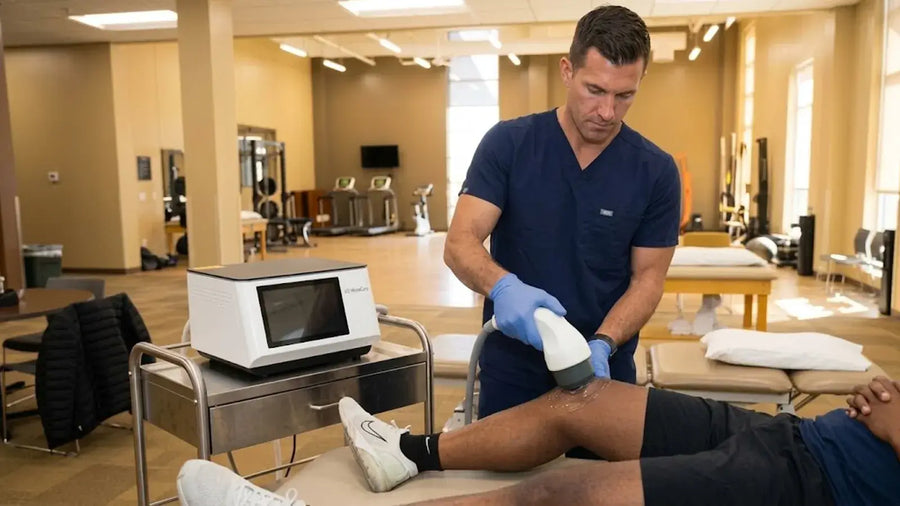
Shockwave therapy is often discussed as one treatment, but clinics may be referring to two different technologies: radial pressure wave therapy and focused shockwave therapy. Both deliver mechanical energy into tissue. What differs is how that energy is generated and distributed.
Radial treats an area. Focused treats a target.
Focused therapy is not automatically the more advanced choice. The better option depends on the location, depth, and size of the intended treatment target.
Terminology note: Radial shockwave therapy is widely used in clinics and online, but radial ballistic systems technically generate radial pressure waves rather than true focused shockwaves. This article uses the familiar term radial shockwave where appropriate while explaining the practical difference between the technologies.
Key Differences at a Glance
A radial system creates mechanical pulses at the applicator. The energy is strongest near the point of skin contact and spreads outward through a relatively broad area.
A focused system generates a shockwave that converges within a defined focal zone. This allows the clinician to direct energy toward a more localized target at a selected depth.
| Comparison | Radial shockwave therapy | Focused shockwave therapy |
|---|---|---|
| Energy pattern | Broad and dispersing | Concentrated within a focal zone |
| Energy distribution | Strongest near the applicator | Concentrated at a selected target |
| Typical treatment field | Larger or more diffuse | Smaller and more localized |
| Common clinical role | Superficial tendons, muscles and myofascial areas | Depth-specific tendon insertions, calcifications and localized lesions |
| Applicator use | Often moved across the treatment area | Positioned more precisely over the intended target |
| Main advantage | Efficient coverage | Precise targeting |
This comparison is more useful than simply asking which device is stronger. A broad treatment field may be exactly what a clinician needs for a large or poorly defined symptomatic area. A concentrated focal zone may be more appropriate when the involved structure has been clearly identified.

The Same Condition Can Require a Different Treatment Field
A condition name cannot decide the technology on its own. Two patients may both have plantar heel pain while presenting with different treatment targets.
Patient A: A Broader Symptomatic Area
The first patient reports discomfort across the heel and plantar soft tissue rather than at one clearly defined point. Radial therapy may be considered because the applicator can move across this wider treatment field.
Patient B: A Localized Target
The second patient has a localized area of chronic pain near the plantar fascia insertion. Examination or imaging may also identify a structural change or calcification. Focused therapy may be considered because the clinician can align a defined focal zone with that target.
The diagnosis may be similar, but the treatment strategy is not. The clinician still needs to ask:
- Is the target broad or localized?
- Is it relatively superficial or depth-specific?
- Has the involved structure been identified through examination or imaging?
The technology should follow the clinical target, not the other way around.


Why the Energy Behaves Differently
The practical difference begins inside the handpiece.
How Radial Pressure Waves Are Generated
Most radial systems use a pneumatic ballistic mechanism. Compressed air accelerates a projectile inside the handpiece, and the impact at the transmitter produces a pressure pulse that enters the tissue through the applicator.
The energy field is broad and strongest near the applicator, which is usually moved through the treatment area. Applicator size also changes the contact area. The WaveCura radial system therefore pairs its pneumatic handpiece with six interchangeable applicators for different muscle, tendon, and myofascial regions.
How Focused Shockwaves Are Generated
Focused systems create shockwaves that converge within a defined focal zone. Depending on the device, they may use electromagnetic, electrohydraulic, or piezoelectric technology. Their purpose is to concentrate energy at an intended location rather than create broad surface coverage.
The focal zone has a measurable size and shape, so depth, energy, coupling, and positioning must be considered together. The WaveCura focused system uses a fluid-cushion handpiece with adjustable settings and guided presets to support setup for a localized target. Clinical assessment still determines the final application.
Where Each Type May Fit in Clinical Practice
Radial and focused systems overlap in some applications. The following table should therefore be read as a treatment-field guide, not as a universal protocol.
| Clinical Presentation / Target | Radial May Be Considered When | Focused May Be Considered When |
|---|---|---|
| Plantar heel pain | The symptomatic area is broader or includes surrounding plantar soft tissue | A localized insertional target or calcification has been identified |
| Achilles tendinopathy | The clinician intends to cover a broader or more superficial tendon region | The target is localized and requires more depth-specific positioning |
| Patellar tendon pain | Sensitivity extends through a larger tendon or surrounding soft-tissue area | A clearly defined tendon region or insertion is being targeted |
| Lateral elbow tendinopathy | The plan includes a broader extensor muscle-tendon area | Examination identifies a localized tendon origin target |
| Shoulder pain | The treatment field includes a broader muscular or superficial soft-tissue region | A specific tendon insertion or calcific deposit has been identified |
| Myofascial trigger points | Multiple points or a larger muscle area require coverage | A small, clearly localized target is the primary concern |
| Calcific tendinopathy | The surrounding tissue is included in a broader treatment strategy | Precise delivery toward a localized deposit is intended |
The table is a guide rather than a universal protocol. Tissue depth, anatomy, treatment goals, clinician training, and device specifications all affect selection.
Displayed pressure or energy should not be interpreted in isolation. Two radial devices set to the same bar value may not create identical pressure fields, and a larger value does not automatically produce a better clinical result.
What the Evidence Shows
There is no universal winner across all musculoskeletal conditions. Some trials favor focused therapy for a particular diagnosis or follow-up period; others report improvement with both technologies or no clinically important difference.
A 2026 systematic review and meta-analysis of tendinopathy studies did not establish consistent overall superiority for pain and function. Differences in conditions, devices, protocols, and follow-up periods limit how broadly one result can be applied.
The technologies are not physically interchangeable, but their technical differences do not prove that one will perform better in every situation. When reading research, clinics should ask:
- Was the study using a radial or focused system?
- What device and applicator were used?
- What condition, target, and treatment protocol were studied?
- Which outcome was measured, and when?
A protocol developed for one device type should not automatically be transferred to another. Shockwave therapy may also need to be combined with loading, strength work, activity modification, and reassessment. The device does not replace diagnosis or rehabilitation.
Which System Fits Your Practice
For a clinic, the decision depends on the targets clinicians see most often and how the system will fit into daily treatment workflows.
A Radial System May Fit Your Practice If:
- You frequently treat larger or more diffuse symptomatic areas.
- Your caseload includes superficial tendons, muscles, and myofascial conditions.
- Interchangeable applicators would help adapt treatment to different body areas.
The WaveCura radial system supports this workflow with a pneumatic ballistic handpiece, six interchangeable applicators, a 1-21 Hz adjustable frequency range, an 8-inch touchscreen, and treatment controls on the handpiece.
A Focused System May Fit Your Practice If:
- You commonly treat clearly localized targets.
- Depth-specific positioning is important to your treatment approach.
- Guided setup and treatment presets would support your clinical workflow.
The WaveCura focused system uses a fluid-cushion applicator, adjustable focal settings, a 10.1-inch touchscreen, and 13 guided body-area presets. The presets support setup, while the clinician remains responsible for confirming the target and final settings.
Does a Clinic Need Both:
Not necessarily. A practice working mainly with broad muscular, myofascial, and superficial tendon areas may find that a radial system fits most of its caseload. A clinic treating localized tendon insertions, calcific presentations, or depth-specific targets may place greater value on focused technology. Access to both can benefit a varied caseload, but that does not mean every patient should receive both treatments.
Before purchasing, consider:
- Which conditions and treatment targets appear most often in your clinic?
- Are those targets usually broad or localized?
- How important is depth-specific positioning?
- What training, protocols, and ongoing product support are available?
The Bottom Line
Radial therapy creates a broader pressure field that is strongest near the applicator. Focused therapy concentrates energy within a defined focal zone for more precise, depth-specific positioning. Neither should be chosen simply because it sounds more powerful.
Radial treats an area. Focused treats a target.
The right system is the one whose treatment field and workflow match the patients a practice intends to treat.
Explore the WaveCura Radial Shockwave System and WaveCura Focused Shockwave System to compare applicators, treatment controls, and workflow features.
Clinical application should follow the device instructions, applicable regulations, appropriate professional training, and an individualized patient assessment.
References
- International Society for Medical Shockwave Treatment (ISMST). Guidelines for Extracorporeal Shockwave Therapy (ESWT). Updated July 2023.
- Loske AM. Shock Waves vs Radial Pressure Waves in Medicine: Physical and Biological Considerations. Medical Research Archives. 2025;13(1):1-14.
- van der Worp H, van den Akker-Scheek I, van Schie H, Zwerver J. ESWT for tendinopathy: technology and clinical implications. British Journal of Sports Medicine. 2013;47(11):e4.
- Schmitz C, Csaszar NB, Milz S, et al. Efficacy and safety of extracorporeal shock wave therapy for orthopedic conditions: a systematic review on contraindications and adverse events. Journal of Orthopaedic Surgery and Research. 2015;10:157.
- Mani-Babu S, Morrissey D, Waugh C, Screen H, Barton C. The effectiveness of extracorporeal shock wave therapy in lower limb tendinopathy: a systematic review. The American Journal of Sports Medicine. 2015;43(3):752-761.
- Bannuru RR, Flavin NE, Vaysbrot EE, Harvey WF, Wang C. High-energy extracorporeal shock-wave therapy for treating chronic calcific tendinitis of the shoulder: a systematic review. Annals of Internal Medicine. 2014;160(8):542-549.
- Ramon S, Moya D, Leal C, et al. Practical guidelines for the clinical application of extracorporeal shock wave therapy in musculoskeletal disorders. Orthopaedic Journal of Sports Medicine. 2020;8(12):2325967120970720.
- Speed C. A systematic review of shockwave therapies in soft tissue conditions: focusing on targeting, imaging guidance, and dosage calibration. British Journal of Sports Medicine. 2014;48(21):1538-1542.